
Imagine wanting to trade your Bitcoin for Ethereum. In the old days of crypto, this meant sending your BTC to a centralized exchange like Binance or Coinbase, waiting for it to settle, swapping it for ETH, and then withdrawing it back to your wallet. You had to trust a third party with your funds during that entire process. Now, picture doing that same swap in one click, directly from your non-custodial wallet, without ever leaving the security of your own device. That is the promise of Cross-Chain DEXs, which are decentralized exchanges that enable seamless cryptocurrency trading across multiple blockchain networks without requiring users to rely on centralized intermediaries.
This technology solves a massive problem in decentralized finance (DeFi): fragmentation. For years, blockchains have operated like isolated islands. If you held assets on Ethereum, they were stuck there unless you wrapped them into synthetic versions to use on other chains. Cross-chain DEXs break down these silos, allowing true interoperability where you can trade any pair on any chain.
How Cross-Chain DEXs Actually Work
You might wonder how a transaction happens between two completely different blockchains that don’t naturally talk to each other. It’s not magic; it’s sophisticated engineering. Unlike traditional bridges that often require you to lock tokens on one side and mint new ones on the other, modern cross-chain DEXs use a combination of asset locking and secure communication protocols.
When you initiate a swap, say from Solana (SOL) to Polygon (MATIC), the platform doesn’t just move data. It uses smart contracts to lock your SOL on the Solana network. Simultaneously, specialized protocols facilitate cross-chain communication, signaling the liquidity pools on Polygon to release MATIC to your wallet. This process relies on three key mechanisms:
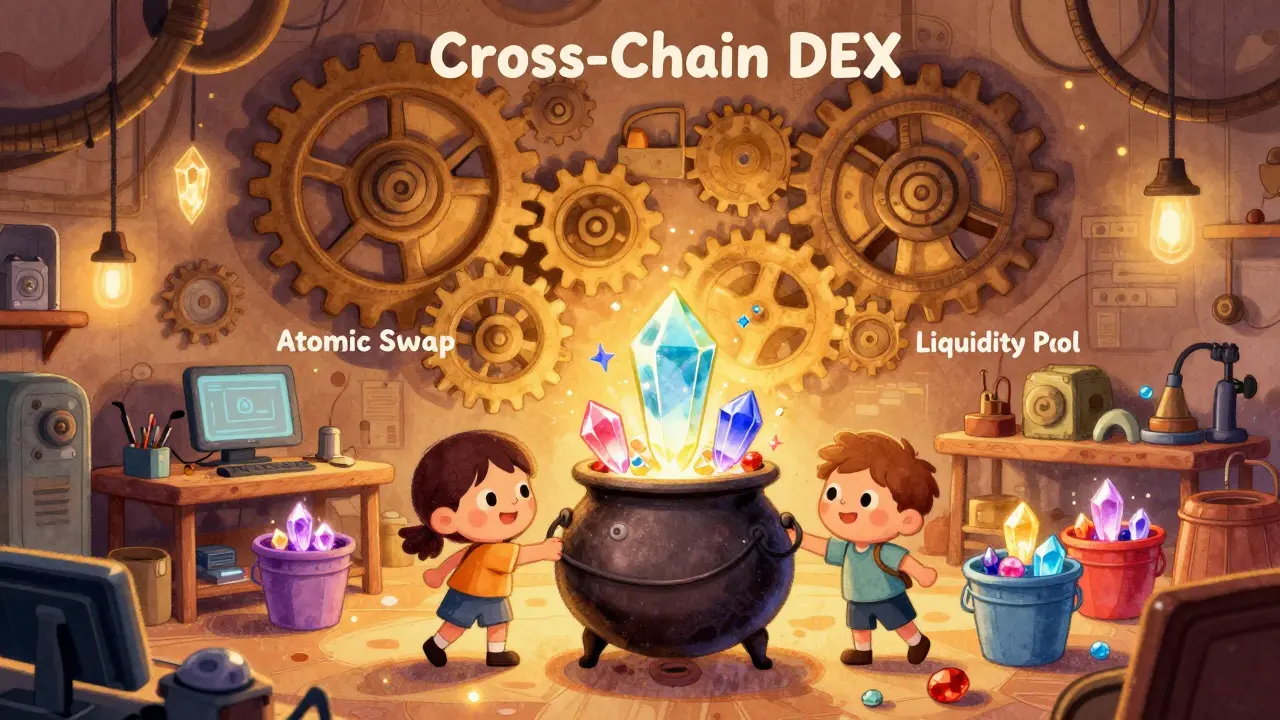
- Atomic Swaps: These ensure that either the entire trade completes successfully on both chains, or it fails entirely, returning your original assets. There is no middle ground where one side goes through and the other doesn’t.
- Aggregated Liquidity Pools: Instead of relying on a single pool of traders, these DEXs source capital from token pools across different networks. This aggregation boosts accessible liquidity significantly.
- Interoperability Protocols: Networks like Axelar Network provide the infrastructure for secure information transmission between blockchains, ensuring that the message "swap completed" is verified before funds are released.
The result? You get direct native asset swaps. You trade real ETH for real SOL, not wrapped versions. This eliminates the counterparty risk associated with wrapped tokens, which have been vulnerable to exploits in the past.
Why You Should Care: The Advantages
If you are already comfortable using single-chain DEXs like Uniswap, why bother with cross-chain platforms? The benefits go beyond convenience. They fundamentally change how you access liquidity and manage risk.
First, consider liquidity fragmentation. On a single-chain DEX, if you want to trade a less popular token, you might face high slippage because there aren't enough buyers or sellers in that specific pool. Cross-chain DEXs aggregate liquidity from multiple ecosystems. According to data from Chainlink, this can offer 3-5x greater effective liquidity for niche pairs compared to single-chain aggregators like 1inch. This means better prices for you.
Second, there is the issue of custody. When you use a centralized exchange, you do not control your private keys. If the exchange gets hacked or freezes withdrawals, your money is at risk. With a cross-chain DEX, 100% of your funds remain in your non-custodial wallet throughout the transaction. You maintain sovereignty over your assets at every step.
Finally, look at the efficiency of native trading. Previously, trading Bitcoin against an Ethereum-based DeFi asset required converting BTC to a wrapped version (WBTC) first. Now, platforms like THORChain allow you to swap native BTC directly for ETH or other tokens. This reduces the number of steps and potential points of failure in your workflow.
The Trade-Offs: Speed, Cost, and Complexity
Nothing in crypto is free, and cross-chain transactions come with their own set of compromises. While the technology is impressive, it is not yet as smooth as clicking 'buy' on a centralized app.
Speed is the most noticeable drawback. Centralized exchanges process cross-chain swaps in under 10 seconds because they handle the ledger updates internally. Cross-chain DEXs, however, must wait for finality on multiple independent blockchains. Even optimized platforms like THORChain typically take 30 to 120 seconds for a transaction to finalize. During periods of network congestion, this time can stretch further, and slippage rates may increase from the typical 0.3-0.5% to 2-3%.
Cost is another factor. You are paying gas fees on at least two different networks. If you are swapping from Ethereum to Solana, you need ETH to pay for the Ethereum gas and SOL to pay for the Solana gas. This requires you to hold small balances of native tokens on multiple chains, adding complexity to your wallet management.
Furthermore, the user interface can be intimidating for newcomers. Understanding concepts like blockchain finality times, multi-step confirmations, and bridge security requires a steeper learning curve. Surveys indicate that while experienced DeFi users adapt within 2-3 hours, beginners often find the process confusing, leading to failed transactions due to incorrect gas settings or timeouts.
Security: The Elephant in the Room
We cannot talk about cross-chain technology without addressing security. In 2022, cross-chain bridges accounted for 64% of all DeFi hack losses, totaling $2.1 billion stolen across 14 major exploits. This history has made users cautious.
However, the landscape has changed since then. Modern cross-chain DEXs employ a multi-layered security approach. Transactions are secured by the underlying blockchain technologies of all involved networks, creating a more robust protection mechanism than single-chain solutions. Projects have responded to past failures by drastically increasing their security budgets. Average audit costs for protocol updates now exceed $350,000, up from $120,000 in 2021.
Despite these improvements, risks remain. Vulnerabilities such as validator collusion, oracle manipulation, and smart contract flaws still exist. Consensys Diligence found that 78% of audited cross-chain implementations contained at least one medium-severity vulnerability related to message verification. As a user, you must do your due diligence. Stick to well-established platforms with transparent security practices and active community oversight.
| Feature | Cross-Chain DEX | Centralized Exchange (CEX) | Single-Chain DEX |
|---|---|---|---|
| Custody of Funds | Non-custodial (User holds keys) | Custodial (Exchange holds keys) | Non-custodial (User holds keys) |
| Asset Type | Native Assets | Various (often fiat-on-ramp) | Native or Wrapped Tokens |
| Transaction Speed | 30-120 seconds | < 10 seconds | Seconds (depending on chain) |
| Liquidity Access | Multi-chain aggregated | Internal order book | Single-chain pools |
| Security Risk | Smart contract/Bridge risk | Hack/Insolvency risk | Smart contract risk |
| Slippage (Typical) | 0.3-0.5% | Variable (often low) | 0.5-1% (higher for niche pairs) |
Leading Platforms in the Space
Not all cross-chain DEXs are created equal. The market is fragmented, but a few players have emerged as leaders based on Total Value Locked (TVL) and reliability.
THORChain currently leads the segment with approximately 45% market share among cross-chain DEXs. Its recent upgrades, including native Bitcoin support without custodial bridges, have solidified its position. It offers deep liquidity for major pairs like BTC/ETH and BTC/SOL.
Chainflip is another significant player, holding around 17% of the market. It focuses on simplicity and speed, aiming to reduce the friction users feel when navigating complex interfaces. Newer entrants like Li.Finance act as aggregators, finding the best routes across various cross-chain protocols to minimize costs for the user.
Infrastructure providers like Axelar Network are also crucial. They don’t always operate a DEX themselves but provide the "Socket" infrastructure that allows other platforms to build unified liquidity pools across 15+ blockchain networks with sub-30-second finality.

Practical Tips for First-Time Users
If you are ready to try a cross-chain swap, preparation is key. Here is how to avoid common pitfalls:
- Hold Native Gas Tokens: Ensure you have small amounts of the native currency for both the source and destination chains. For example, if swapping from Ethereum to Avalanche, you need ETH for gas on Ethereum and AVAX for gas on Avalanche.
- Check Finality Times: Be patient. Do not refresh your page repeatedly if the transaction seems slow. Check the status on a block explorer to see if the confirmation is pending on the source or destination chain.
- Start Small: Before moving large sums, execute a test transaction with a minimal amount. This verifies that your wallet is configured correctly and helps you understand the fee structure.
- Verify Contracts: Only use official websites and verified contract addresses. Phishing sites targeting cross-chain users are common. Bookmark the official links beforehand.
- Monitor Slippage Settings: During high volatility, set your slippage tolerance slightly higher (e.g., 1-2%) to prevent the transaction from failing due to price changes during the longer execution time.
The Future of Interoperability
The trajectory for cross-chain DEXs is upward. Industry analysts predict that cross-chain DEX volume will grow at a 142% compound annual growth rate through 2025, potentially reaching $1.2 trillion annually. Institutional adoption is driving this growth, with firms using these platforms for Bitcoin-Ethereum arbitrage strategies.
Future developments focus on standardization and security. Collaborations between ecosystems like Cosmos and Axelar aim to create unified cross-chain communication protocols. Additionally, integrations with oracle networks like Chainlink will bring reliable price feeds directly into cross-chain infrastructure, reducing the risk of manipulation.
While Layer 2 scaling solutions may eventually reduce the need for some cross-chain activity by making Ethereum the de facto settlement layer, the diversity of the blockchain ecosystem ensures that interoperability will remain a critical component of DeFi for years to come. Cross-chain DEXs are not just a trend; they are the necessary plumbing for a truly connected financial system.
What is a cross-chain DEX?
A cross-chain DEX is a decentralized exchange that allows users to trade cryptocurrencies across different blockchain networks (e.g., Ethereum to Solana) directly from their wallets without using centralized intermediaries or wrapped tokens.
Are cross-chain DEXs safe?
They are generally safer than centralized exchanges regarding custody since you keep your private keys. However, they carry smart contract and bridge risks. Historical data shows bridges have been targeted by hackers, so it is crucial to use reputable platforms with rigorous audits.
Why are cross-chain transactions slower than CEX trades?
Cross-chain DEXs must wait for transaction finality on multiple independent blockchains. This involves verifying the lock on the source chain and the release on the destination chain, which takes 30-120 seconds, whereas centralized exchanges update internal ledgers instantly.
Do I need wrapped tokens to use a cross-chain DEX?
No. One of the main advantages of modern cross-chain DEXs like THORChain is that they enable native asset swaps. You trade the actual Bitcoin or Ethereum, eliminating the risks associated with wrapped token wrappers.
Which cross-chain DEX is the best?
THORChain is currently the leader in terms of Total Value Locked (TVL) and market share, offering deep liquidity for major pairs. Chainflip and Li.Finance are also strong contenders, with Li.Finance acting as an aggregator to find the best rates across multiple protocols.