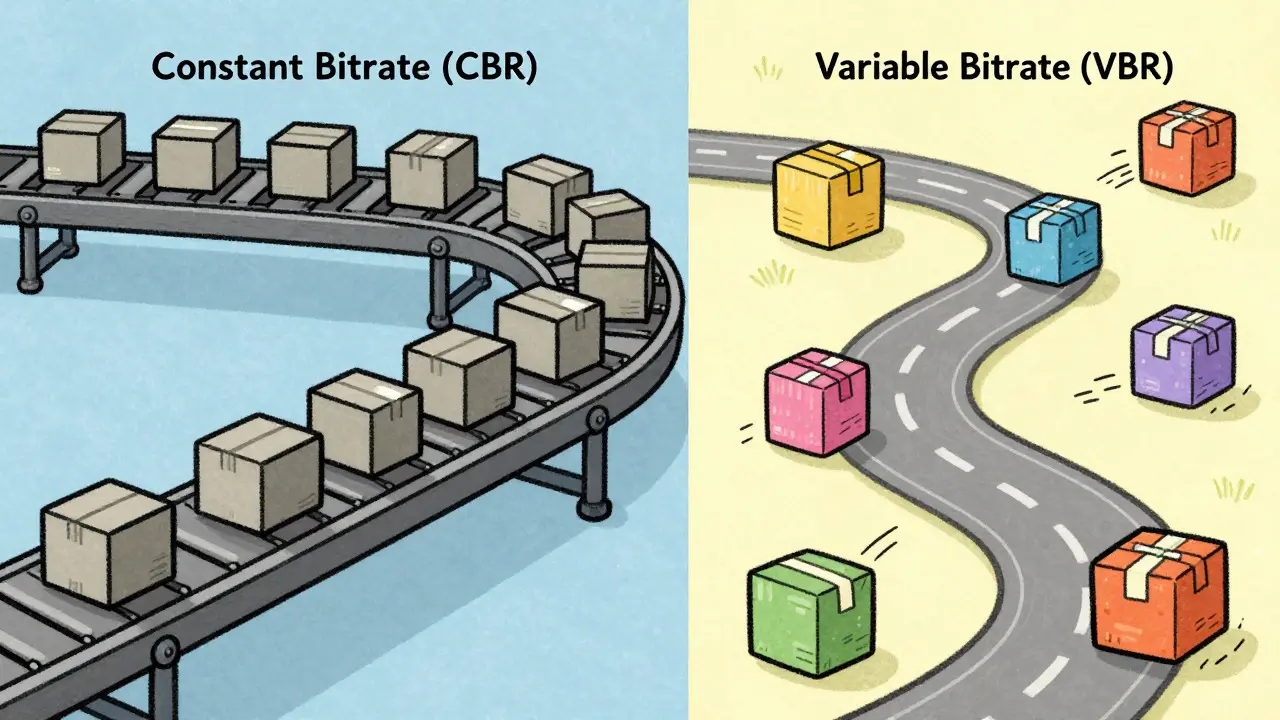
Imagine you are designing a voice-over-IP system for a global company. You have two choices for how the audio gets from one person's ear to another's: keep the data stream steady like a metronome, or let it fluctuate like a conversation naturally does. This is the core difference between Constant Bitrate (CBR) and Variable Bitrate (VBR). It sounds like a minor technical detail, but this choice dictates your network costs, call quality, latency, and even how secure your conversations are against eavesdroppers.
If you pick the wrong approach, you might waste money on unnecessary bandwidth or suffer from choppy audio during busy periods. Let’s break down exactly how these two methods work, why major platforms like Zoom and Teams prefer one over the other, and when you should actually switch gears.
How CBR Keeps Things Predictable
Constant Bitrate (CBR) is a rate-control strategy where the encoded audio stream maintains a fixed target rate per unit of time, regardless of the complexity of the speech content. Think of it like a conveyor belt moving at a set speed. Whether the package is heavy or light, the belt moves at the same pace.
In VoIP, classic codecs like ITU-T G.711 operate as CBR sources. They generate packets that are nearly identical in size and timing throughout a call. According to traffic analysis supplements, the variation in packet lengths for CBR codecs is "almost always zero." This consistency is a gift to network engineers.
- Simplified Capacity Planning: You can calculate total bandwidth needs by simply adding up the peak rates of each codec plus protocol overhead. No complex math required.
- Stable QoS Policies: Routers and switches can easily prioritize these predictable flows because they know exactly what to expect.
- Low Latency: Because there is no need for large buffer windows to smooth out fluctuations, CBR streams introduce minimal delay.
However, predictability comes at a cost. If the speaker is silent or speaking softly, a CBR codec still sends full-sized packets filled with redundant data. It doesn’t care if the content is simple; it just keeps pushing bits. This inefficiency becomes glaringly obvious when you scale up to thousands of simultaneous calls.
How VBR Maximizes Efficiency
Variable Bitrate (VBR) is an encoding method that dynamically adjusts the number of bits allocated per frame based on spectral complexity, energy levels, and the presence of speech versus silence. Unlike CBR, VBR acts like an intelligent driver who slows down for traffic and speeds up on open roads.
Modern VoIP codecs like Speex and Opus support VBR modes. These encoders analyze each audio frame before sending it. If the speaker is talking clearly, the encoder uses more bits to preserve quality. If there is silence or background noise, it drastically reduces the bitrate. Some implementations use "silence suppression," treating the codec as an on-off source.
| Feature | Constant Bitrate (CBR) | Variable Bitrate (VBR) |
|---|---|---|
| Bandwidth Usage | Fixed, often higher average usage | Dynamic, up to 50% savings with silence suppression |
| Predictability | High (constant packet sizes) | Low (variable packet sizes) |
| Quality per Bit | Lower (wastes bits on simple content) | Higher (allocates bits where needed) |
| Network Engineering | Simple capacity planning | Complex statistical multiplexing models |
| Security Profile | Better resistance to traffic analysis | Vulnerable to metadata leakage |
The benefits are significant. Research shows that enabling silence suppression and treating flows as VBR sources can cut overall bandwidth usage by about 50% compared to always-on CBR streams. On constrained Wide Area Network (WAN) links, this means you can fit twice as many calls into the same pipe without degrading Mean Opinion Scores (MOS).
The Security Trade-off: Metadata Leakage
Here is where things get interesting. Most people think encryption solves all privacy problems, but encrypted VoIP traffic still leaks metadata-specifically, packet sizes and timings. This is known as traffic analysis.
When using VBR, an adversary can look at the varying packet sizes and infer conversational patterns. A burst of larger packets likely indicates active speech, while smaller packets suggest silence. In a 2017 study, Wire’s WebRTC team highlighted that Opus defaults to VBR, which allows attackers to map out the rhythm of a conversation even if they cannot hear the words.
To counter this, some security-focused applications switch to CBR. By keeping packet lengths uniform, CBR masks the dynamics of speech. Koen Vos, co-author of the Opus codec, estimated that CBR incurs around 10-30% higher bitrate overhead than VBR during typical calls because it cannot compress silence effectively. However, for sensitive communications where preventing traffic analysis is critical, this extra bandwidth cost is often worth it.

Why Major Platforms Prefer CBR
You might wonder why giants like Microsoft Teams, Zoom, and Discord rely heavily on CBR or constrained-CBR strategies internally. The answer lies in user experience and compatibility.
- Device Compatibility: Not all hardware handles variable bitrates well. Some older sound cards or network interfaces may glitch or drop packets when faced with unpredictable data bursts. CBR ensures stable performance across millions of different devices.
- Jitter Buffer Management: Real-time communication requires tight control over latency. VBR streams typically employ larger buffer windows to accommodate rate swings. Larger buffers mean higher latency, which kills the natural flow of conversation. CBR allows for smaller, tighter buffers.
- Operational Simplicity: For platform providers, debugging issues is easier when the data flow is consistent. As noted by streaming providers like Castr, mainstream conferencing tools prioritize predictable latency and stable performance over theoretical bandwidth savings.
This isn't to say VBR is dead in real-time comms. It’s just that the industry has converged on CBR as the default for live interactions because it minimizes support tickets and ensures robust performance across heterogeneous networks.
When Should You Choose VBR?
Despite the dominance of CBR in consumer apps, there are specific scenarios where VBR shines. If you are building a specialized VoIP solution, consider VBR if:
- Bandwidth is Extremely Scarce: On narrow-bandwidth links like 2G mobile networks or satellite connections, VBR can squeeze acceptable voice quality into very limited throughput. It aggressively reduces bitrate during silence, keeping the connection alive when CBR would choke.
- You Are Recording Calls: If the primary goal is archiving rather than live transmission, VBR offers superior quality per byte. You get clearer audio for the same storage cost.
- Statistical Multiplexing is Key: In large-scale deployments with thousands of concurrent calls, the "on-off" nature of VBR allows for better utilization of WAN resources through statistical multiplexing. You don’t need to provision for every single call being at peak volume simultaneously.
Hybrid approaches also exist. "Constrained CBR" allows modest fluctuations around a target rate, offering some efficiency benefits of VBR while retaining enough predictability for network engineering. Similarly, "Peak VBR" sets an upper limit on instantaneous bitrate, making it safer for streaming scenarios.

Practical Implementation Tips
If you are configuring VoIP codecs today, here is how to make the right call:
For Live Conferencing: Stick with CBR or Constrained CBR. Configure your jitter buffers tightly to minimize latency. Ensure your Quality of Service (QoS) policies reserve fixed bandwidth for these flows. This aligns with recommendations from VideoSDK and Microsoft, who advise CBR when network predictability and low latency are top priorities.
For Cost-Sensitive WAN Links: Enable Silence Suppression and use VBR modes in codecs like Opus or Speex. Monitor your Mean Opinion Score (MOS) closely to ensure quality doesn’t dip during high-complexity speech segments. Be prepared to tune your admission control algorithms to account for bursty traffic patterns.
For High-Security Environments: Force CBR mode even if it increases bandwidth costs. Mask the metadata by padding packets to a uniform size. Accept the 20-30% bitrate overhead as the price of privacy. This approach is endorsed by security researchers who warn against the risks of traffic analysis in VBR streams.
Looking Ahead: Adaptive Strategies
The future of VoIP codecs lies in adaptive hybrid strategies. As networks become more dynamic, static choices between pure CBR and pure VBR may fade. Next-generation systems will likely respond dynamically to changing network conditions, switching between modes based on real-time jitter, packet loss, and available bandwidth.
Research into variable-bit-rate vocoders continues to refine how we balance quality, efficiency, and stability. With the rise of end-to-end encryption and growing concerns about metadata leakage, we may see a resurgence of CBR-like behaviors in security-focused protocols. Meanwhile, advancements in AI-driven compression could allow VBR to achieve even greater efficiencies without sacrificing the predictability needed for real-time interaction.
Ultimately, there is no single "best" option. CBR gives you control and simplicity. VBR gives you efficiency and quality. Your choice depends on whether you value a smooth, predictable ride or maximum mileage for your bandwidth budget.
Does CBR provide better audio quality than VBR?
Not necessarily. At equivalent average bitrates, VBR often produces better perceived audio quality because it allocates more bits to complex speech segments and fewer to simple ones. However, CBR provides more consistent quality without sudden drops, which can be preferable in noisy environments or for users sensitive to variability.
Which codec supports both CBR and VBR?
The Opus codec is widely regarded as the gold standard for modern VoIP and supports both CBR and VBR modes efficiently. Other codecs like Speex also offer variable bitrate options. Legacy codecs like G.711 are strictly CBR.
How much bandwidth can VBR save compared to CBR?
With silence suppression enabled, VBR can reduce overall bandwidth usage by approximately 50% compared to always-on CBR streams. Without silence suppression, the savings are smaller, typically around 10-20%, depending on the amount of talk spurt activity.
Is VBR safe for encrypted VoIP calls?
While the payload is encrypted, VBR leaks metadata through varying packet sizes, allowing adversaries to perform traffic analysis and infer conversation patterns. For high-security needs, CBR is preferred because it masks these dynamics with uniform packet sizes, despite the higher bandwidth cost.
Why do platforms like Zoom use CBR instead of VBR?
Platforms prioritize low latency, device compatibility, and operational simplicity. CBR allows for tighter jitter buffers and simpler network engineering, ensuring a stable experience across millions of diverse devices and network conditions. VBR’s variability can introduce complexity and potential glitches on unsupported hardware.