
You just lost money. Maybe it was a bad crypto investment, a wire transfer that went sideways, or a romance scam that drained your savings. You’re frustrated, angry, and looking for a way out. Then, the phone rings. Or maybe an email lands in your inbox from someone claiming they can get your money back. They sound professional. They know exactly how much you lost. They even have a case number.
Here is the hard truth: if you are waiting for a stranger to magically return your lost funds, you are likely walking into a second trap. This brings us to a critical distinction that confuses many victims: the difference between a bounty hunter (a licensed bail enforcement agent) and a recovery scammer. These two roles are worlds apart in legality, function, and risk. One operates under strict state laws with specific mandates; the other is often a criminal operation targeting vulnerable people who have already been defrauded once.
The Myth of the Financial Bounty Hunter
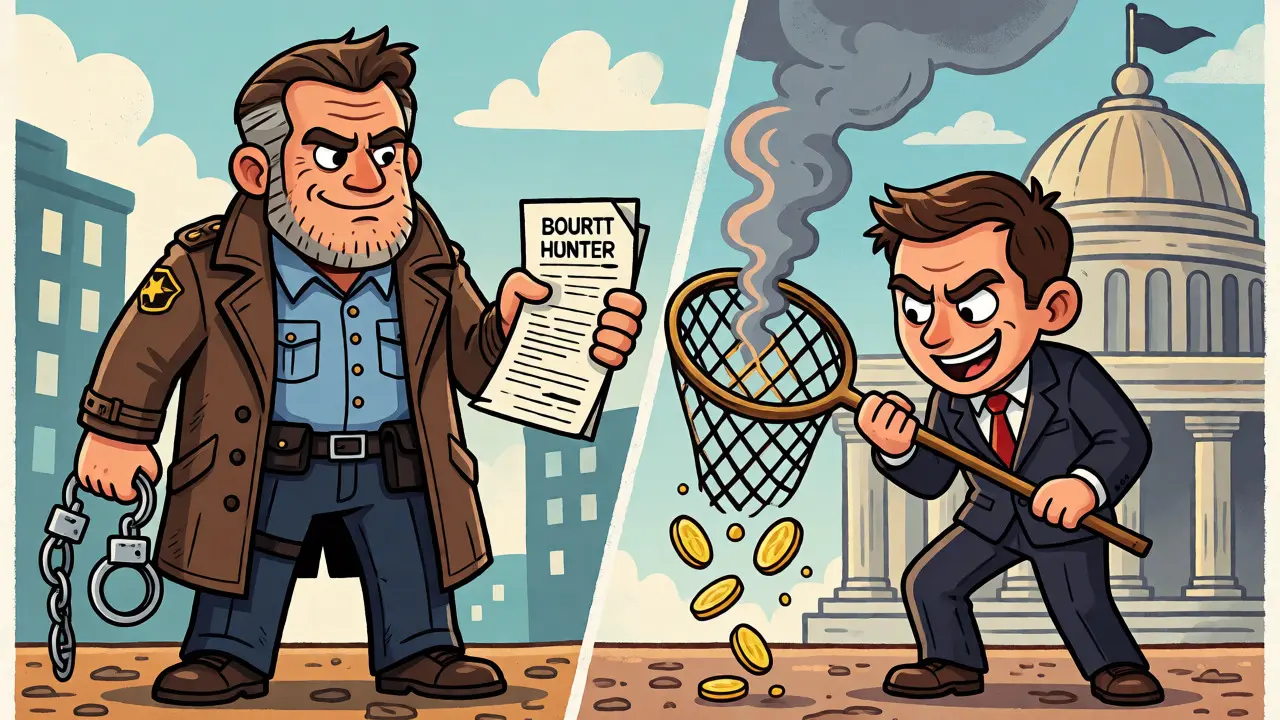
When most people hear "bounty hunter," they picture Dog the Bounty Hunter chasing down a fugitive on live TV. In reality, a bail enforcement agent, commonly known as a bounty hunter, has a very narrow legal job. Their primary role is to locate and apprehend individuals who failed to appear in court after being released on bail. They work under contract with a bail bond agency, not directly for the victim of a financial crime.
This role is heavily regulated. For example, in New York, agents must be at least 25 years old, complete approved training, and maintain a $500,000 surety bond. Florida law explicitly prohibits unlicensed persons from acting as bail enforcement agents. Crucially, a real bounty hunter does not recover stolen cryptocurrency, unlock frozen bank accounts, or retrieve losses from a Ponzi scheme. If someone calls themselves a "financial bounty hunter" promising to trace and seize digital assets for an upfront fee, they are misusing the term. There is no universal "bounty" system for private debt collection or fraud recovery in the United States.
How Recovery Scammers Operate
A recovery scam, also known as refund fraud or recovery-room fraud, targets people who have already lost money. The scammers prey on hope. They claim to be lawyers, government agencies, or specialized tech firms capable of retrieving your funds. But there is a catch: they demand payment before any money is returned.
The Federal Trade Commission (FTC) identifies several red flags. These include demands for "retainer fees," "processing charges," "taxes," or "insurance premiums" to release recovered funds. The CFTC warns that these fees often escalate. You pay a small amount, then another, then another, while the promised payout remains just out of reach. Between February 2023 and February 2024, victims reported over $9.9 million in additional losses specifically from this type of scheme, according to FBI data.
These scammers use sophisticated social engineering. They might impersonate the SEC, the FBI, or well-known law firms. They may ask for your private keys, seed phrases, or remote access to your computer. A legitimate professional never needs your private key to help you file a report or sue a defendant. If they ask for it, they want control of your remaining assets.
Who Can Actually Help? Legitimate Paths to Recovery
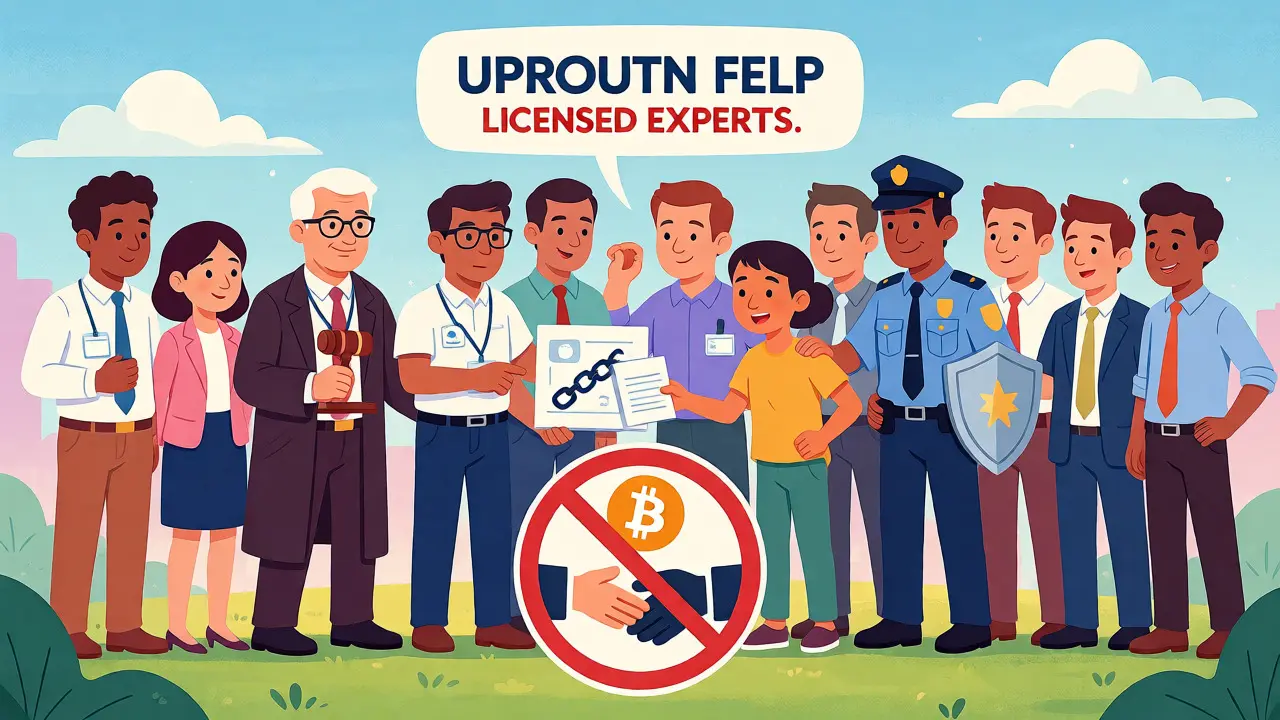
If you cannot trust random callers, who should you trust? The answer lies in verifiable professionals and official institutions. A legitimate path to recovery involves three main players: law enforcement, licensed attorneys, and blockchain analytics firms.
Law Enforcement: The FBI’s Internet Crime Complaint Center (IC3) is the primary hub for reporting cybercrime. As of July 2025, the FBI’s Operation Level Up had notified over 8,000 cryptocurrency-investment-fraud victims, helping prevent more than $500 million in further losses. However, police do not charge you a fee to investigate. If a "police officer" asks for Bitcoin to process your case, it is a scam.
Licensed Attorneys: A lawyer can analyze your jurisdiction, send lawful demands, and file civil lawsuits. They may seek injunctions to freeze assets. Unlike scammers, a reputable attorney will sign a clear engagement letter outlining their scope of work. They will not guarantee results because litigation is uncertain. Be wary of any lawyer who promises a 100% recovery rate.
Blockchain Analytics: Companies like Chainalysis track on-chain transactions. They can follow funds through intermediary wallets to identify potential exchange cash-out points. For instance, the $3.6 billion Bitcoin connected to the 2016 Bitfinex hack was recovered after six years of tracing. However, Chainalysis states clearly that it does not recover funds directly for individuals. Tracing provides evidence; it does not reverse a transaction. You still need law enforcement or legal action to seize those assets.
| Role | Primary Function | Regulation Status | Payment Structure | Risk Level |
|---|---|---|---|---|
| Bail Enforcement Agent | Apprehends fugitives on bail | State-licensed (e.g., NY, FL) | Paid by Bond Agency | Low (if verified) |
| Recovery Scammer | Promises fund retrieval | Unregulated/Criminal | Upfront fees, escalating costs | High (Loss of more money) |
| Licensed Attorney | Legal representation, litigation | Bar Association Licensed | Retainer + Hourly/Contingency | Moderate (Cost vs. Outcome) |
| Blockchain Analyst | Traces transaction paths | Private Company | Service Fee | Low (Evidence only) |
The Scale of the Problem
Why are these scams so prevalent? Because the volume of fraud is exploding. The FBI’s 2025 IC3 report recorded 181,565 cryptocurrency-related complaints, a 21% increase from the previous year. Reported losses hit $11.366 billion. Recovery scams alone generated 10,516 complaints and $1.4 billion in losses. When thousands of people lose money every day, there is a massive market for predators offering false hope.
The FTC reported $12.5 billion in total consumer fraud losses in 2024. Investment scams were the largest category. With such high stakes, victims often feel desperate enough to pay a "fee" to save a larger sum. Scammers exploit this psychological vulnerability. They create urgency, telling you that you must act within hours to secure your settlement.
Checklist: How to Verify a Professional
Before handing over any money or personal information, run through this verification process. Do not rely on the contact details provided by the person reaching out to you.
- Verify Licensing: If they claim to be a lawyer, check their status on your state bar association’s website. If they claim to be a bail agent, check the state Department of State or relevant regulatory body.
- Independent Contact: Call the firm using a phone number found independently online, not the one on their business card or email signature. Scammers often set up fake call centers.
- No Private Keys: Never share your seed phrase or private key. No legitimate service needs this to file a complaint or conduct research.
- Written Agreement: Ensure there is a clear contract detailing services, fees, and refund policies. Vague verbal promises are a major warning sign.
- Check Court Dockets: If they mention a lawsuit or judgment, look it up yourself on public court records databases like PACER (for federal cases) or local county clerk sites.
What To Do Immediately After a Loss
If you suspect you’ve been scammed, stop all communication with the original scammer and any alleged recovery agents. Preserve every piece of evidence: wallet addresses, transaction hashes, emails, usernames, and screenshots. Notify your bank or exchange immediately through their official app or website-not via a link sent to you.
File a report with the FBI’s IC3. This helps build investigative intelligence. Report securities matters to the SEC and commodities issues to the CFTC. Consult an independently selected attorney only after verifying their credentials. Remember, rapid reporting supports investigation, but it rarely guarantees immediate repayment. Government restitution processes, such as DOJ remission, can take months or years and are discretionary.
Trust is earned through transparency and regulation, not through promises of quick riches. Stick to verified institutions and licensed professionals. Avoid anyone who contacts you unsolicited, guarantees results, or asks for upfront cryptocurrency payments to "release" your funds.
Can a bounty hunter recover my stolen cryptocurrency?
No. A traditional bounty hunter (bail enforcement agent) is licensed to apprehend people who skipped bail. They do not have the legal authority or technical capability to seize cryptocurrency or recover financial losses from fraud. Anyone claiming otherwise is likely using the term incorrectly to confuse you.
Why do recovery scammers ask for taxes or insurance fees?
They use these terms to justify taking more money from you. Legitimate tax authorities or insurance companies do not require you to pay them directly via cryptocurrency or wire transfer to release a settlement. These fees are fabricated to keep you paying until you run out of funds.
Is it safe to hire a private investigator for crypto recovery?
It can be, but you must verify their license and experience. A PI can gather evidence and trace connections, but they cannot force a transfer reversal. Ensure they provide a written scope of work and do not promise guaranteed recovery. Always check reviews and references independently.
What is the biggest red flag of a recovery scam?
The biggest red flag is an unsolicited offer to recover funds for an upfront fee. Legitimate lawyers and investigators usually require you to seek them out, not the other way around. Additionally, if they ask for your private key or seed phrase, it is definitely a scam.
Does the FBI charge a fee to investigate my case?
No. Law enforcement agencies, including the FBI, do not charge victims a fee to investigate crimes or file reports. If someone claims to be from the FBI or IC3 and asks for payment to proceed with the investigation, it is a scam.