
Imagine you are watching a race where two runners are neck and neck. Suddenly, one stumbles, but then catches up. Who wins? In the world of blockchain is a decentralized digital ledger technology that records transactions across many computers so that any involved record cannot be altered retroactively without the alteration of all subsequent blocks, this question isn't about medals; it's about which version of history becomes the truth. This is where fork choice rules come in. They are the invisible referees that decide which chain of blocks is the "real" one when the network splits.
If you have ever wondered why Bitcoin moves slowly while Ethereum aims for speed, or how networks prevent bad actors from rewriting history, you need to understand these rules. Specifically, we are looking at the classic Longest Chain Rule versus the more complex GHOST protocol. These aren't just technical details; they define the security, speed, and reliability of the entire system.
What Are Fork Choice Rules?
In a distributed network like Bitcoin is the first cryptocurrency created by Satoshi Nakamoto in 2009, using proof-of-work consensus, thousands of nodes (computers) work independently. Sometimes, two miners find a block at almost the exact same time. The network splits into two temporary versions. One node sees Block A as the latest, another sees Block B. This is called a fork.
A fork choice rule is the algorithm that every node runs to decide which branch to follow. It must be deterministic, meaning if everyone has the same data, they all reach the same conclusion. Without this rule, the network would never agree on the state of the ledger, leading to chaos and double-spending risks. The goal is simple: converge on a single canonical chain quickly and securely.
The Longest Chain Rule: Simplicity and Security
The Longest Chain Rule is the original method, introduced with Bitcoin. Its logic is brutally simple: the valid chain is the one with the most cumulative proof-of-work. In practice, this usually means the chain with the most blocks. If Chain A has 10 blocks and Chain B has 9, everyone switches to Chain A. The blocks on Chain B become "orphaned" and are discarded.
This approach works well because it aligns incentives. Miners want their work to count, so they build on the chain that is already winning. Since the majority of honest computing power (hash rate) will naturally extend the longest chain, it grows faster than any competing fork. Eventually, the gap becomes too large for an attacker to overcome.
- Simplicity: Easy to implement and verify. Nodes only need to compare block counts or total difficulty.
- Proven Track Record: Has secured billions of dollars in Bitcoin value since 2009 without major consensus failures.
- Decentralization: Low barrier to entry for full nodes, as they don't need to process complex subtree calculations.
However, there is a catch. The longest chain rule assumes that blocks take time to propagate across the network. If you try to make blocks appear faster (say, every 1 minute instead of 10), forks happen more often. When forks happen frequently, many blocks get orphaned. Orphaned blocks represent wasted energy and lost revenue for miners. This creates a bottleneck: you can't easily increase transaction throughput without sacrificing stability.
GHOST Protocol: Maximizing Network Efficiency
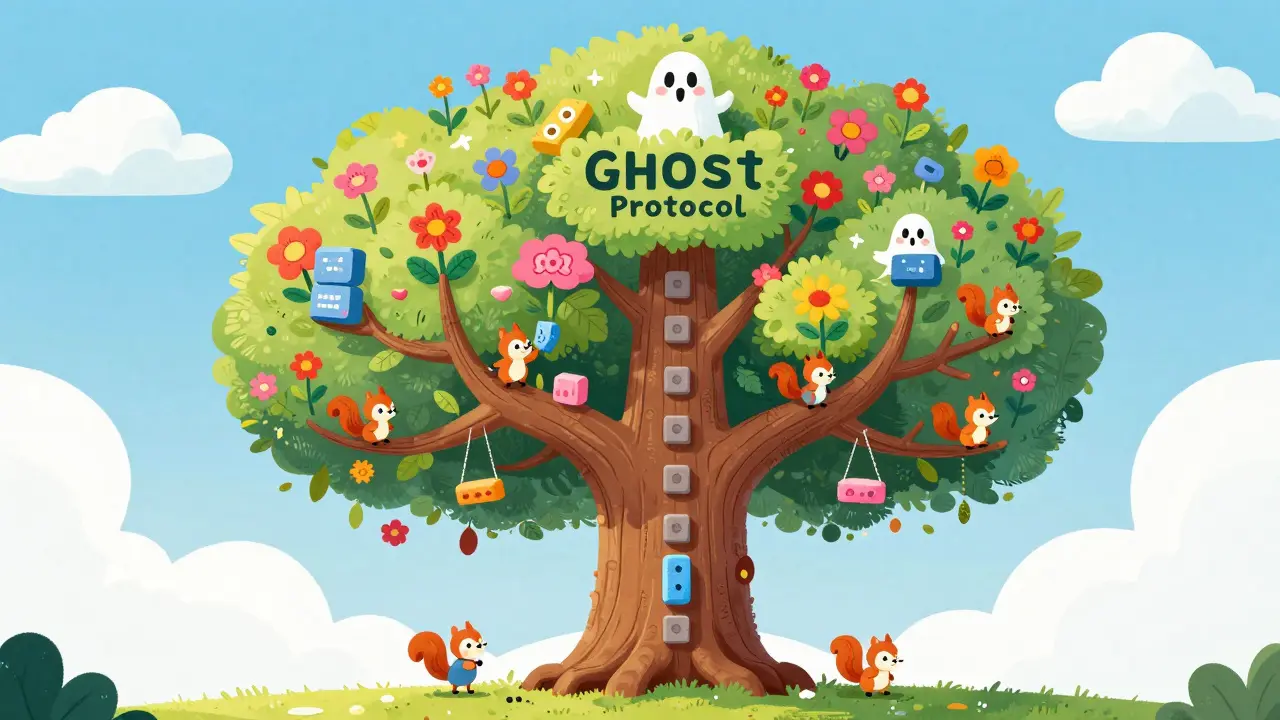
To solve the orphaning problem, researchers Yonatan Sompolinsky and Aviv Zohar proposed GHOST stands for Greedy Heaviest Observed Subtree, a fork choice rule designed to improve blockchain throughput by including orphaned blocks in the weight calculation in 2013. Instead of looking only at the longest linear path, GHOST looks at the "heaviest" subtree.
Here is how it works. Imagine a tree structure. The main trunk is the canonical chain. But branches stick out. In the longest chain rule, those branches are ignored once the trunk passes them. In GHOST, the weight of those branches still counts toward the parent block they connect to. So, if a side branch has a lot of work done on it, that work contributes to the weight of the main line it attached to.
This allows networks to produce blocks much faster. Even if a block doesn't end up in the direct main chain, its computational work isn't wasted. It adds weight to the chain it was built upon. This significantly reduces the incentive for miners to withhold blocks or engage in selfish mining strategies, making the network more resilient against certain attacks.
| Feature | Longest Chain Rule | GHOST Protocol |
|---|---|---|
| Primary Metric | Cumulative Proof-of-Work (Depth) | Heaviest Subtree Weight |
| Orphaned Blocks | Discarded (Wasted Work) | Included in Weight Calculation |
| Block Time Suitability | Slow (e.g., 10 minutes) | Fast (e.g., seconds) |
| Complexity | Low | High |
| Security Against Selfish Mining | Vulnerable at high fork rates | More Resilient |
| Notable Users | Bitcoin, Litecoin | Ethereum (Classic), Ethereum 2.0 (LMD-GHOST) |
LMD-GHOST: The Evolution in Ethereum 2.0
While original GHOST was designed for Proof-of-Work systems, Ethereum 2.0 transitioned to Proof-of-Stake consensus, requiring a new fork choice rule adapted for validator attestations rather than mining work needed something different. Enter LMD-GHOST, or Latest Message Driven GHOST.
In Proof-of-Stake, validators don't mine blocks; they vote on them. LMD-GHOST modifies the GHOST principle to use these votes. Each validator sends one attestation per epoch, indicating which block they support. The fork choice rule selects the chain that maximizes the sum of voting power behind each block, considering the latest message from each validator.
This adaptation is crucial for scalability. It allows Ethereum to process transactions rapidly while maintaining security. However, LMD-GHOST does not provide instant finality on its own. It tells you which chain is currently the most likely to be correct, but it doesn't guarantee that a block won't be reverted later. That's why Ethereum layers additional mechanisms like Casper FFG (Finality Gadget) on top to lock in blocks permanently.
Security Trade-offs: No Free Lunch
You might think GHOST is strictly better because it handles speed and efficiency. But in cryptography, there is no free lunch. Every design choice introduces new vulnerabilities.
The Longest Chain Rule is vulnerable to "selfish mining" attacks if block times are too short. An attacker can hide blocks and release them strategically to gain more revenue than their share of hash power suggests. GHOST mitigates this by valuing side chains, making such attacks less profitable.
However, GHOST introduces exposure to "avalanche attacks." In this scenario, an attacker releases a massive burst of blocks simultaneously, creating a heavy subtree that temporarily overwhelms the honest network's ability to process and respond. Because GHOST weighs recent activity heavily, the attacker can manipulate the chain tip. Researchers continue to debate the practical feasibility of this attack, but it highlights that GHOST requires careful parameter tuning.
Furthermore, the complexity of GHOST makes it harder for lightweight clients to verify the chain. In Bitcoin, a smartphone app can easily check if a chain is longer by counting blocks. In GHOST-based systems, verifying the heaviest subtree requires more computational resources and data, potentially centralizing validation among powerful nodes.
Which Rule Should You Choose?
If you are building a new blockchain, your choice depends on your goals.
Choose the Longest Chain Rule if:
- You prioritize maximum decentralization and ease of implementation.
- Your application can tolerate slower transaction speeds (e.g., store of value).
- You want to minimize the risk of novel, untested attack vectors.
Choose GHOST or LMD-GHOST if:
- You need high throughput and fast block times.
- You are operating in a Proof-of-Stake environment.
- You have the engineering resources to handle complex consensus logic and security audits.
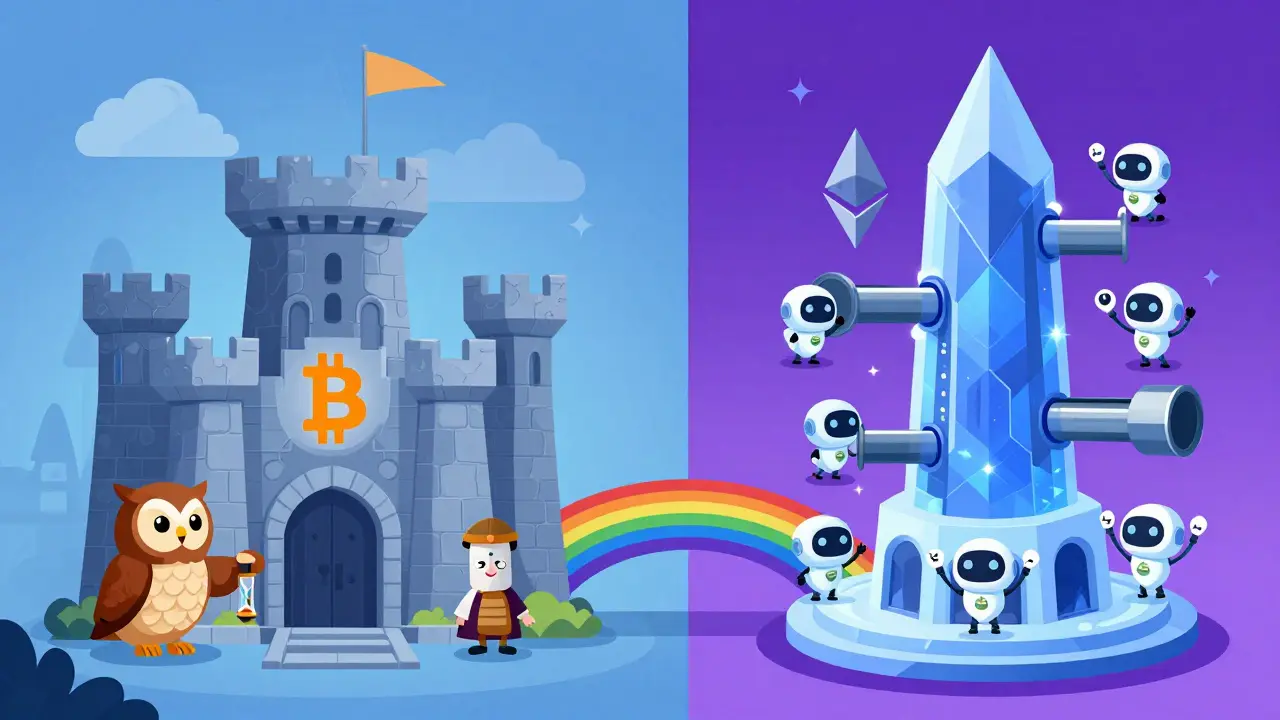
Bitcoin sticks with the longest chain because its 10-minute block time keeps fork rates low enough that orphaning isn't a critical issue. Ethereum adopted GHOST variants because it needed to scale beyond Bitcoin's limits. Both choices are rational given their specific constraints.
Why does Bitcoin still use the Longest Chain Rule?
Bitcoin uses the Longest Chain Rule because its 10-minute block interval results in very few forks. The simplicity of the rule ensures that even the weakest devices can participate in verification, maximizing decentralization. Changing it now would introduce unnecessary risk to a highly secure, established network.
Is GHOST faster than the Longest Chain Rule?
GHOST enables faster block production without increasing the rate of orphaned blocks. While the rule itself doesn't directly speed up transactions, it allows the network to set shorter block times safely, which leads to faster confirmation times for users.
What is the difference between GHOST and LMD-GHOST?
Original GHOST is designed for Proof-of-Work systems, measuring weight by computational effort. LMD-GHOST is adapted for Proof-of-Stake, measuring weight by validator votes (attestations). LMD-GHOST also considers only the latest vote from each validator to prevent double-voting manipulation.
Can an attacker easily manipulate GHOST?
GHOST is resistant to selfish mining but theoretically vulnerable to avalanche attacks, where an attacker floods the network with blocks. However, executing such an attack requires significant resources and precise timing, making it difficult in practice. Networks mitigate this through other security layers.
Do fork choice rules affect finality?
Fork choice rules determine the current "head" of the chain but do not inherently provide finality. Finality means a block can never be reverted. Most modern systems, like Ethereum, combine fork choice rules (like LMD-GHOST) with separate finality gadgets to ensure permanent settlement.