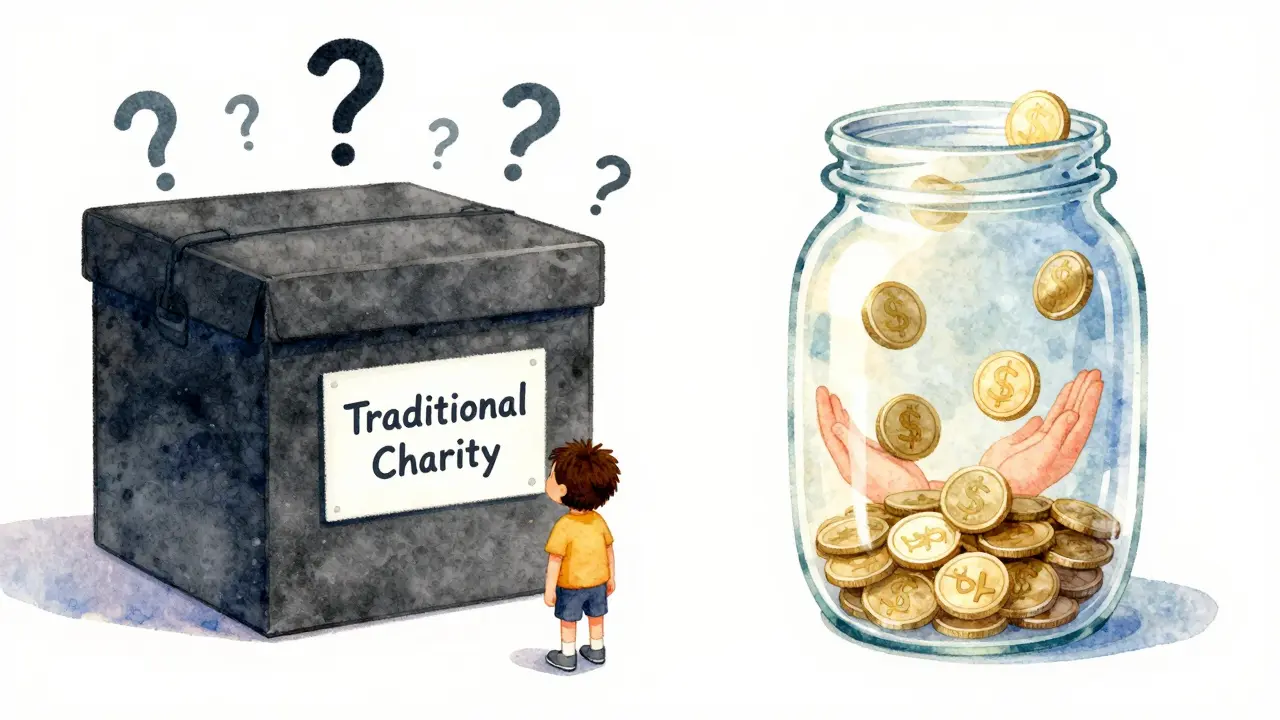
You’ve probably been there. You see a heartbreaking story online, you open your wallet, and you send money to help. But then what? The money disappears into a digital black hole. You get an email receipt, maybe a vague annual report months later, but you never truly know if that $50 bought medicine, built a school, or got lost in administrative fees. That feeling of uncertainty is exactly why the charitable sector is undergoing a massive shift right now.
Enter Blockchain for Charity, which is the application of distributed ledger technology to create immutable, transparent records of philanthropic transactions. It’s not just about paying with Bitcoin anymore. It’s about solving the trust deficit that has plagued nonprofits for decades. By moving donations onto a public, tamper-proof ledger, we can finally answer the question every donor asks: "Where did my money go?"
The Trust Deficit in Traditional Philanthropy
Before we talk about code, let’s talk about people. According to research from IJRASET, donors are increasingly concerned about how their contributions are used. Historically, the relationship between a donor and a beneficiary was opaque. Money moved through banks, intermediaries, and multiple layers of management before reaching its destination. At each step, visibility dropped and risk rose.
This opacity hides missteps. When financial movements aren’t visible, it becomes easy for funds to be misallocated or, in worst-case scenarios, embezzled. Even when charities are honest, the lack of real-time data makes it hard to prove efficiency. Blockchain addresses this by creating an open record where inspection replaces doubt. As noted by Osiz Technologies, accountability rises when steps in spending cannot vanish. This isn't just a technical upgrade; it's a cultural reset for how we view giving.
How Transparent Donation Tracking Actually Works
If you’re worried that blockchain is too complex for everyday giving, think again. The user experience is designed to be seamless, while the backend does the heavy lifting. Here is the anatomy of a modern blockchain-based donation:
- The Public Ledger: Every transaction is recorded on a decentralized network. Unlike a private bank database, this ledger is open for anyone to audit. As documented by IJERT, this ensures that every donation is recorded in an open, verifiable way that can be traced by donors and recipients alike.
- Cryptographic Security: Each transaction is secured with advanced cryptography. Once a block is added to the chain, it cannot be altered. This immutability means that no administrator can go back and change the amount or destination of a donation after the fact.
- Real-Time Monitoring: Modern platforms integrate blockchain explorers directly into their interfaces. Firefly Giving notes that these tools display every transaction on public ledgers, making it impossible to hide financial movements. Donors can watch their contribution flow from their account to the nonprofit in real time.
The result is an unbroken chain of custody. You don’t have to take the charity’s word for it. You can see the digital footprint of your generosity yourself.
Smart Contracts: Automating Integrity
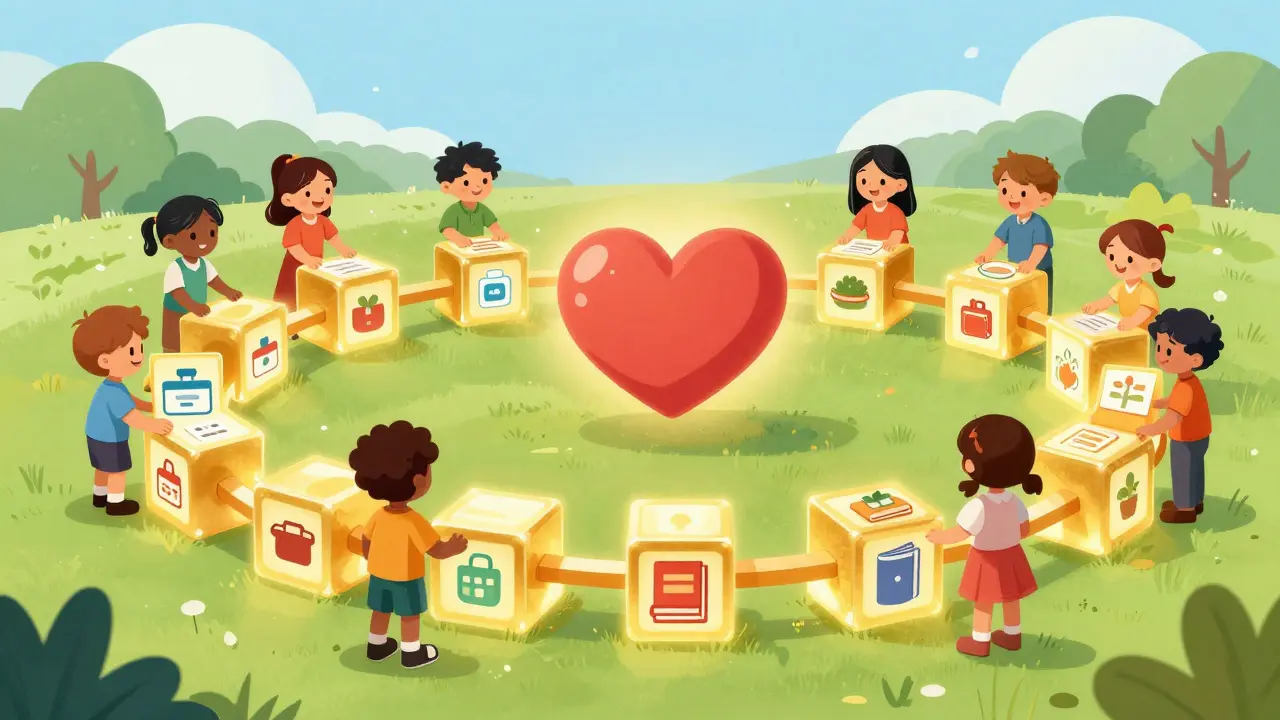
The real magic happens with Smart Contracts, which are self-executing contracts with the terms of the agreement directly written into code. These are not legal documents signed by lawyers; they are automated programs that run on the blockchain.
In a traditional setup, a charity receives funds and then decides how to spend them. With smart contracts, the rules are set in advance. For example, a contract might state: "Release these funds only when proof of delivery for medical supplies is uploaded and verified." If the condition isn’t met, the money stays locked. No human oversight is needed, and fewer opportunities for fraud exist.
IJERT highlights that these Donation Distribution Smart Contracts transfer funds to recipients according to preset conditions without waiting for manual approvals. This eliminates delays and ensures that funds are released only when specific milestones are satisfied. It turns fundraising from a hopeful promise into a guaranteed execution.
Case Study: LUXARITY and Consensys Social Impact
Let’s look at a real-world example to see this in action. LUXARITY, a platform focused on ethical consumption, partnered with Consensys Social Impact to revolutionize their annual pre-loved luxury pop-up sale. They didn’t just accept donations; they registered and tracked every single one on the blockchain.
Here’s how it worked for the donor:
- A customer buys a pre-loved item.
- The proceeds are designated as a donation.
- The donor specifies exactly which cause they want to support-such as education grants, environmental causes, or recycling efforts.
- The transaction is recorded on the blockchain.
According to Consensys, these donations are 100% transparent and traceable. Consumers can track their money from their digital wallet all the way to the grant beneficiary. This level of specificity allows donors to feel a direct connection to the outcome. It’s not just "helping the environment"; it’s "funding this specific recycling initiative." This concrete visibility builds a deeper emotional and financial commitment.
Benefits Beyond Transparency
While transparency is the headline feature, blockchain brings other critical advantages to the table. Let’s break down the value proposition using a comparison of traditional vs. blockchain-enabled systems.
| Feature | Traditional Model | Blockchain Model |
|---|---|---|
| Transparency | Annual reports, delayed updates | Real-time, public ledger access |
| Fraud Risk | Higher due to manual processes | Minimal due to immutability and automation |
| Intermediaries | Banks, payment processors (high fees) | Direct peer-to-peer transfers (lower fees) |
| Trust Mechanism | Based on reputation and promises | Based on cryptographic proof and action |
| Speed of Distribution | Days to weeks for cross-border transfers | Near-instant via smart contracts |
One major benefit is efficiency. Outdated manual steps are replaced by automatic processes. IJERT notes that this system aims to eliminate inefficiencies and ensure contributions reach those in need without interference. When you remove intermediaries, you also reduce transaction costs. More of your dollar goes to the cause, not the middleman.

Challenges and Limitations in 2026
It’s important to keep our feet on the ground. Blockchain isn’t a silver bullet. While the technology is mature, adoption in the nonprofit sector is still growing. One challenge is the technical barrier for older or smaller organizations. Implementing a blockchain solution requires expertise in distributed ledger technology, which can be expensive upfront.
Another issue is scalability. Some blockchains struggle with high transaction volumes, leading to slower processing times or higher gas fees during peak usage. However, newer Layer-2 solutions are addressing these bottlenecks. Additionally, regulatory clarity around crypto-assets varies by country, which can complicate international donations. Despite these hurdles, the trajectory is clear. Nonprofits are responding to donor demands for transparency by integrating these tools, as seen in the convergence of blockchain data with engaging storytelling and infographics mentioned by Firefly Giving.
Future Directions for Donor Engagement
Where do we go from here? The future of charity isn’t just about tracking money; it’s about tokenizing impact. We’re seeing the rise of token-based contributions where donors receive tokens representing their share of a project’s success. These tokens can be traded or redeemed, creating a new economy of philanthropy.
Osiz Technologies is already designing adaptable fundraising platforms that feature these smart contracts alongside token mechanisms. Automation of operations is emerging, making transaction safety and record visibility standard rather than exceptional. As more charities adopt these systems, the baseline for trust will rise. Donors will expect to see the blockchain explorer link next to the "Donate" button. Those who don’t provide it may find themselves losing credibility in an increasingly skeptical market.
Is blockchain donation tracking secure?
Yes, highly. Blockchain uses cryptographic security to protect transactions. Because the ledger is decentralized and immutable, once a donation is recorded, it cannot be altered or deleted by any single party. This makes it significantly more resistant to fraud than traditional centralized databases.
Do I need to understand cryptocurrency to donate via blockchain?
Not necessarily. Many modern platforms allow you to donate using fiat currency (like USD or EUR), which they convert to stablecoins or native tokens behind the scenes. You can track the donation on the blockchain without ever holding a crypto wallet yourself, though having one gives you more control and lower fees.
What are smart contracts in charity?
Smart contracts are automated programs that release funds only when predefined conditions are met. For example, a smart contract might hold donation funds until a charity uploads verified photos of a completed construction project. This ensures money is used exactly as intended without manual oversight.
Can I track my donation in real-time?
Yes. Blockchain platforms provide real-time monitoring capabilities. Through integrated blockchain explorers, you can see the status of your transaction instantly. Unlike traditional banking, which can take days to settle, blockchain transactions are often confirmed within minutes, providing immediate visibility.
Are there fees associated with blockchain donations?
There are usually lower fees compared to traditional credit card processing or international wire transfers. However, some blockchains charge "gas fees" for processing transactions. Many charitable platforms absorb these costs or use low-fee networks to ensure that the maximum amount reaches the beneficiary.