The global effort to fight climate change has a massive problem: we can't actually trust most of the receipts. For years, the Voluntary Carbon Market (VCM) has been a bit of a wild west. Companies buy credits to offset their emissions, but the system is plagued by "double counting"-where the same ton of CO2 reduction is sold to two different buyers-and a complete lack of transparency in how these credits are measured. It's hard to know if a forest in the Amazon is actually being protected or if the credit is just a piece of paper with no real-world impact.
This is where Blockchain enters the picture. By moving carbon accounting from private spreadsheets to a public, immutable ledger, we can finally track a carbon credit from the moment it's created until it's "retired" (used up). Instead of trusting a middleman's word, we can verify the data ourselves. This isn't just about crypto; it's about building a digital infrastructure for climate finance that actually works.
The Core Problem: Why Traditional Carbon Markets Fail
To understand why we need a new system, you have to look at the flaws in the old one. Traditional carbon markets rely on fragmented registries. If you're a company buying offsets, you're often dealing with a complex web of certifying bodies, each with different standards. This creates a "signal vs. noise" problem where buyers can't tell a high-quality project from a low-quality one.
The most damaging issue is double counting. In a traditional system, a project developer might sell the same credit to a firm in New York and a firm in London because there isn't a single, shared ledger to track ownership in real-time. This undermines the entire goal of the Paris Agreement, which requires countries to meet specific emissions targets without cheating the math.
How Tokenization Turns Air into Assets
The magic happens through Tokenization. In simple terms, a verified carbon credit is turned into a digital token-often an NFT (Non-Fungible Token). Unlike a generic coin, an NFT can carry a massive amount of metadata. When a credit is tokenized, the NFT doesn't just say "1 Ton of CO2"; it includes the project ID, the location, the date of verification, and the specific methodology used to measure the carbon capture.
This process usually follows a specific workflow to ensure the token has real value:
- Validation: A registry verifies that the carbon was actually captured or avoided.
- Issuance: The registry creates a digital representation of that credit.
- Deployment: The token is minted on a blockchain like Polygon, Ethereum, or Base.
- Trading & Retirement: The token is traded between parties and eventually "burned" (destroyed) when the buyer claims the offset, ensuring it can never be sold again.
By using these networks, we move from a slow, manual process to one that supports fractional ownership and API-based automation. For a corporate sustainability officer, this means they can automate their offsetting strategy via software rather than spending months on manual audits.

Modernizing Measurement: The Role of Digital MRV
You can't have a trustless ledger if the data going into it is garbage. This is where MRV (Monitoring, Reporting, and Verification) comes in. Traditional MRV involves people flying to a forest with clipboards and tape measures once every few years. It's slow and prone to human error.
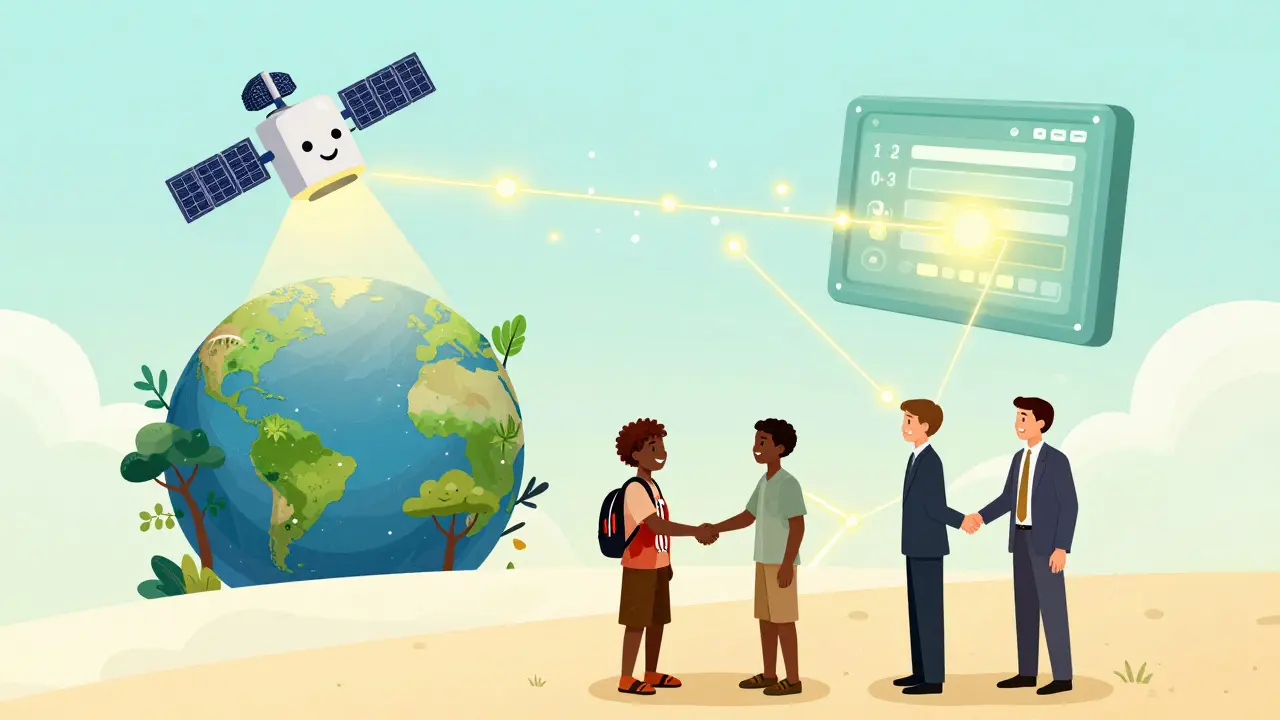
The new approach, known as Digital MRV, integrates Internet of Things (IoT) devices, satellite imagery, and AI. For example, instead of a manual count, satellites can use LiDAR to measure the biomass of a forest in real-time. This data is fed directly into the blockchain. If the forest burns down in a wildfire, the data reflects it immediately, and the associated carbon credits can be adjusted or flagged. This creates a living record of the project's performance rather than a static snapshot from three years ago.
| Feature | Traditional VCM | Blockchain-Enabled System |
|---|---|---|
| Transparency | Siloed registries, opaque pricing | Public ledger, real-time pricing |
| Double Counting | High risk due to fragmented data | Virtually eliminated via immutability |
| Verification | Manual, periodic audits | Digital MRV (Satellites, IoT, AI) |
| Settlement | Days or weeks via intermediaries | Instant peer-to-peer settlement |
The Infrastructure: Meta-Registries and Smart Contracts
One of the biggest breakthroughs in this space is the concept of the meta-registry. Think of this as a "registry of registries." Instead of forcing every organization to use one single platform, a meta-registry aggregates metadata from various sources into one public database. This allows EcoRegistry, Carbonmark, and other platforms to talk to each other.
Then there are Smart Contracts. These are self-executing contracts where the terms are written directly into the code. In a carbon market, a smart contract can be programmed to automatically release payment to a project developer only when a satellite confirms a certain amount of tree growth. This removes the need for a trusted third party to hold the money in escrow and ensures that the people actually doing the work get paid faster.
Navigating the Market: Who is Leading the Charge?
Several players are attempting to bridge the gap between legacy climate finance and the blockchain. KlimaDAO and Toucan Protocol have been pioneers in bringing carbon credits on-chain, allowing them to be traded as liquid assets. Meanwhile, established giants like Verra-the world's largest carbon standard-are beginning to integrate blockchain to modernize their legacy systems.
The goal here isn't just to make trading easier. It's to create a market where a small-scale farmer in Kenya can prove they've captured carbon and sell that credit directly to a company in Germany without losing 50% of the value to brokers and consultants. By removing the regional bias and the middlemen, blockchain democratizes access to climate finance.
The Road to 2030: What's Next?
We are currently moving from the "experimental" phase to the "infrastructure" phase. By 2030, we can expect AI-driven accounting to be the standard. We'll likely see a world where every physical asset (like a wind farm or a protected mangrove) has a "digital twin" on the blockchain that updates its carbon value in real-time.
However, technology can't solve everything. Blockchain can track a credit, but it can't force a government to pass a law protecting a forest. The real victory will happen when these decentralized tools are paired with the political will to enforce strict environmental standards. When that happens, the "carbon credit" will move from being a controversial marketing tool to a legitimate financial instrument for saving the planet.
What exactly is double counting in carbon markets?
Double counting happens when the same carbon offset is claimed by more than one entity. For example, if a project developer sells a credit to a company to offset its emissions, but the host country also counts that same reduction toward its own national target under the Paris Agreement, the atmospheric benefit is counted twice, which is a mathematical error that inflates climate progress.
How does an NFT differ from a standard carbon credit?
A standard credit is often just an entry in a private database. A tokenized credit (as an NFT) is a digital asset on a public ledger. It contains immutable metadata-like GPS coordinates and verification dates-and can be transferred instantly across the globe without needing a central authority to approve the trade.
Is blockchain itself energy-intensive, and does that defeat the purpose?
This was a major concern with early Proof-of-Work systems like the original Ethereum. However, most modern carbon tracking uses Proof-of-Stake networks (like Polygon or the current Ethereum 2.0) which use 99% less energy. The efficiency gained in auditing and preventing fraud far outweighs the minimal energy cost of the ledger.
What is a meta-registry?
A meta-registry is a blockchain-based layer that aggregates data from multiple different carbon registries. Instead of having one single global registry (which is politically difficult), a meta-registry allows different systems to sync their data, making it possible to track a credit as it moves between different platforms and jurisdictions.
Can blockchain stop "greenwashing"?
It can't stop a company from claiming they are "green," but it makes it much harder to lie about the data. Because the records are immutable and public, any discrepancy between a company's claims and the actual on-chain data can be spotted by independent researchers, NGOs, and the public.