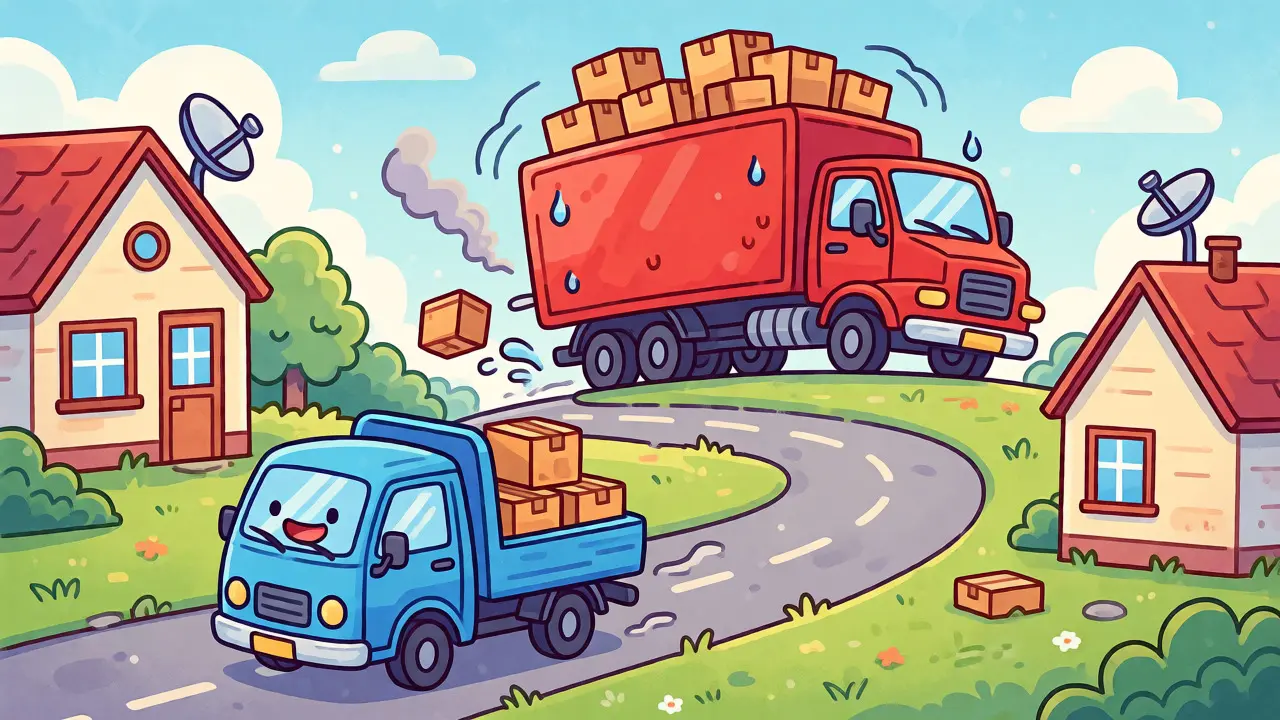
You’ve probably heard the claim that a bigger block means more transactions. It sounds logical. If a truck carries more boxes, you move more goods per trip. But in blockchain networks, making the truck bigger doesn’t just mean carrying more; it means the truck moves slower, costs more to fuel, and might get stuck in traffic before everyone sees it arrived. This is the core tension of block size and block time. These two parameters are the hard limits that dictate how fast a network can process payments, how secure it remains against attacks, and whether your neighbor can still run a node on their home laptop.
Think of blockchain performance as a balancing act between three competing desires: speed (throughput), security (finality), and decentralization (node accessibility). You can usually pick two. If you want high speed and high security, you often sacrifice decentralization because only powerful servers can keep up. If you want decentralization and security, you sacrifice speed. Understanding the mechanics of block size and block time is the only way to see where a specific chain sits on this triangle.
The Throughput Equation: Why Bigger Isn’t Always Better
At its simplest, throughput-the number of transactions processed per second (TPS)-is roughly calculated by dividing the usable capacity of a block by the time interval between blocks. If Bitcoin allows 1 MB of data every 10 minutes, the math is straightforward. But this linear view ignores physics. When you increase block size, you increase the amount of data that must be propagated across the entire peer-to-peer network. Every validator needs to download, verify, and store that data before they can build on top of it.
If a block takes too long to spread from New York to Tokyo, different parts of the network will temporarily disagree on which block came last. In Proof-of-Work systems like Bitcoin, this leads to "orphaned" or stale blocks, wasting energy and reducing security. In Proof-of-Stake systems, it can cause validators to miss their turn to propose or vote, leading to reduced participation. A 2024 European Commission report highlighted this exact trade-off: shrinking the block time reduces user wait times but increases the risk of forks if propagation isn't instant.
This isn't just theoretical. The Bitcoin-NG research paper explicitly states that Bitcoin’s processing rate is capped by these two factors. They argued that simply cranking up the numbers without improving network topology creates instability. So, when developers tweak these settings, they aren't just changing a dial; they are re-engineering the network's physical constraints.
Bitcoin’s Conservative Approach: Stability Over Speed
Bitcoin represents the extreme end of the conservatism spectrum. Its target block time is approximately 10 minutes, and its maximum block weight is limited to 4 million weight units (roughly equivalent to 1 MB of serialized data under Segregated Witness rules). This design choice wasn't accidental. Satoshi Nakamoto chose these values to ensure that even someone with a modest internet connection could run a full node and validate the entire history independently.
Why does this matter? Because if only massive data centers can afford the bandwidth and storage to handle larger blocks, regular users stop validating. They start trusting RPC providers instead. This centralization threat was the heart of the "Blocksize Wars" of 2015-2017. Proponents of larger blocks, like Gavin Andresen, wanted lower fees through higher capacity. Opponents, including many Core developers, feared that 8 MB or 32 MB blocks would make running a node prohibitively expensive for the average person.
| Parameter | Bitcoin | Ethereum |
|---|---|---|
| Target Block Time | ~10 minutes | 12 seconds |
| Capacity Metric | Weight Units / Bytes | Gas Units |
| Max Capacity | 4M Weight Units (~1MB) | 60M Gas (Limit) / 30M Gas (Target) |
| Throughput Est. | ~1-3 TPS | ~15-30 TPS |
Bitcoin didn't solve its scaling problem by blowing up the base layer. Instead, it leaned into Layer 2 solutions like the Lightning Network. By keeping the base layer slow and heavy, Bitcoin prioritizes settlement finality and decentralization over high-frequency trading speeds.

Ethereum’s Multidimensional Limits: Gas, Not Just Bytes
Ethereum took a different path. It realized that measuring a block solely in bytes is flawed because not all transactions cost the same. Sending ETH is cheap computationally; executing a complex smart contract loop is expensive. Therefore, Ethereum uses gas as its primary constraint. A block has a gas limit (currently targeting 30 million gas, with a hard cap around 60 million) rather than a strict byte size.
This distinction is crucial. Two blocks could have the exact same byte size, but one might take twice as long to execute because it contains complex DeFi interactions while the other contains simple transfers. Ethereum’s slot time is fixed at 12 seconds. This short interval drastically reduces the time you wait for your transaction to be included-averaging about 6 seconds compared to Bitcoin’s 5-minute average wait.
However, Ethereum faces its own propagation challenges. With a 12-second window, validators have very little time to receive, execute, and broadcast the new state. If the network gets congested, blocks can be missed, leading to "empty slots." Recent proposals like EIP-7782 suggest cutting slot time to 6 seconds to halve latency further, but this puts immense pressure on hardware and network reliability. Ethereum is also introducing "blobs"-large chunks of data specifically for Layer 2 rollups-to separate data availability costs from execution costs, acknowledging that one-size-fits-all block limits don't work for modern dApps.
The Scalability Trilemma in Action
The scalability trilemma posits that you cannot simultaneously maximize scalability, security, and decentralization. Block size and block time are the levers you pull to navigate this trilemma.
- Increase Block Size: You boost throughput (Scalability). But larger blocks take longer to propagate and require more disk space and RAM. This raises the barrier to entry for nodes, potentially hurting Decentralization. If nodes drop out, Security might weaken due to fewer independent verifiers.
- Decrease Block Time: You improve user experience (lower latency). But shorter intervals give less time for propagation. This increases the chance of forks (temporary disagreements on the chain tip), which can hurt Security and create confusion for applications relying on immediate finality.
- Keep Both Small/Fast: You maintain high Decentralization and Security (easy to verify, frequent updates). But you sacrifice Scalability, forcing users onto Layer 2s or paying high fees during congestion.
Chains like Solana attempt to break the trilemma by assuming better hardware. Solana uses a tiny packet size (1,232 bytes) but produces blocks incredibly fast using parallel execution and leader-based scheduling. It trades off some decentralization (requiring beefier validator machines) for massive throughput. Avalanche takes another route, allowing subnets to define their own gas limits, effectively letting communities choose their position on the trilemma curve.
Practical Implications for Developers and Users
What does this mean for you? If you’re building a decentralized exchange (DEX), you care about latency and finality. Ethereum’s 12-second blocks mean you wait ~6 seconds for inclusion, but true economic finality takes longer. On Bitcoin, you wait minutes for confirmation, making it unsuitable for real-time retail point-of-sale unless you use Lightning.
For infrastructure providers, the stakes are financial. Running an Ethereum node requires syncing gigabytes of data daily. If block sizes grow, so do storage costs. If block times shrink, CPU usage spikes. You need to monitor metrics like block propagation percentiles (how long it takes for 90% of peers to see a block) and orphan rates. If your node consistently falls behind, you lose rewards.
Users should understand that "slow" doesn't always mean "bad." Bitcoin’s slowness is a feature, ensuring that the ledger is immutable and secure against double-spends. Ethereum’s flexibility comes with complexity. When you pay a high gas fee, you’re essentially bidding for space in a constrained computational resource, not just a byte of data.
Frequently Asked Questions
Does increasing block size automatically increase transaction speed?
No. While it increases the potential throughput per block, it also increases the time required to propagate the block across the network. If propagation time exceeds the block interval, it causes forks and instability, which can actually degrade network performance and security.
Why does Ethereum use gas instead of block size?
Because computational effort varies wildly between transactions. A simple transfer is cheap to process, while a complex smart contract call is expensive. Using gas ensures that a block containing heavy computations doesn't overload validators' CPUs, even if the raw byte size is small.
What is the relationship between block time and fork rate?
Shorter block times generally increase the fork rate in globally distributed networks. Validators have less time to receive the previous block before producing the next one. If they haven't received it, they might build on an older block, creating a temporary fork that eventually resolves but wastes resources.
Can we just change both block size and time to scale infinitely?
No. There are physical limits to bandwidth and CPU speed. Increasing both parameters pushes the bottleneck to other areas, such as state access speed, signature verification, or storage I/O. Eventually, the network becomes centralized because only specialized hardware can keep up.
How do Layer 2 solutions affect block size limits?
Layer 2 solutions like Rollups batch thousands of transactions into a single proof or data blob submitted to the main chain (Layer 1). This effectively bypasses the base-layer block size limit for individual transactions, allowing high throughput without requiring the base layer to process every single swap or transfer.